
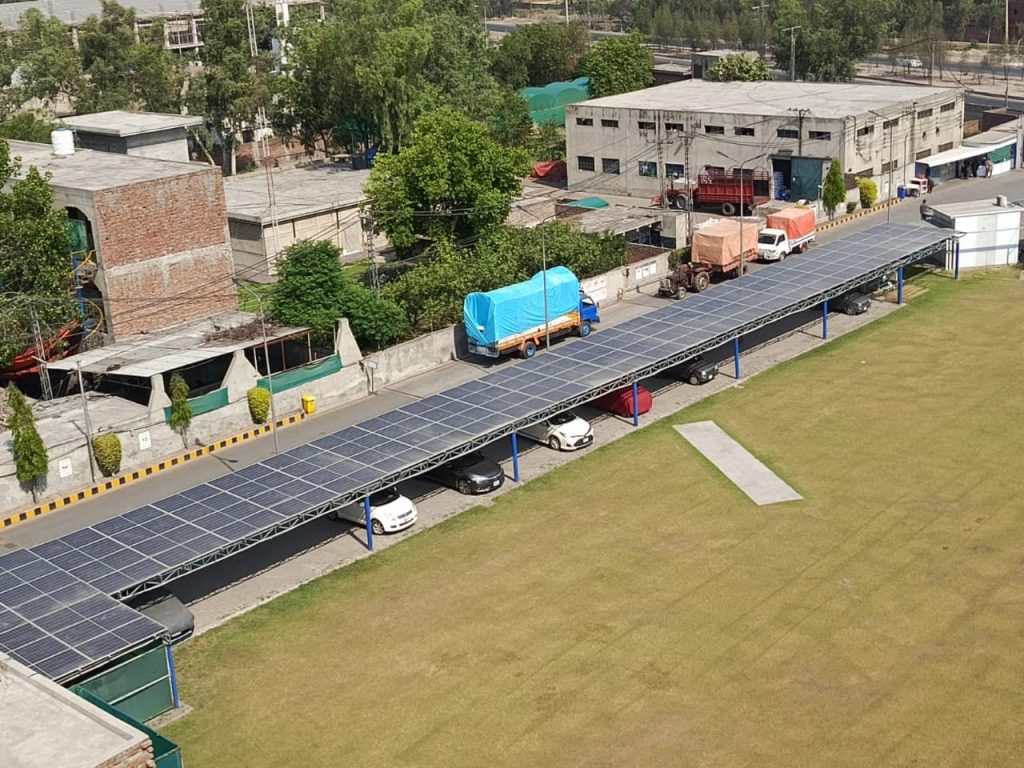
Pakistan doesn’t lack sunlight, and it doesn’t lack carports. What it lacks is the connective infrastructure that turns these carports into a solution for the other. A solar carport is exactly that: a structure built to shade parked vehicles, using solar panels as the shade itself, cooling the ground below while generating electricity above it. For a country that badly needs more robust energy infrastructure, it’s an opportunity that’s barely been touched.
Why carports, and why now?
Pakistan’s solar sector has largely grown around two models: grid-scale farms and rooftop residential or commercial installs. Both matter, but both overlook a category of land that’s sitting in plain sight parking. Hospitals, universities, factories, shopping plazas, government complexes, and airports all have large parking lots doing nothing but absorbing heat.
Covering that space with solar canopies does several things at once:
- It generates power close to where it’s consumed.
- It shields vehicles and pedestrians from brutal summer heat.
- It puts already-developed land to work without competing with agriculture for space.
- It requires no new land acquisition itself, an increasingly difficult proposition in Pakistan.
Globally, carports are growing faster than the broader commercial solar market because they solve a land problem as much as an energy one. Pakistan’s dense urban centers have no shortage of spaces like this sitting idle. Building out this kind of infrastructure is a practical way to pair energy security with economic growth.
The technical reality: this is construction, not a panel installation.
Unlike a conventional rooftop system, a carport is a fundamentally different build, a distinction many new EPCs entering the space have failed to grasp. A commercial carport is a steel structure roughly 20–25 feet tall, anchored into the ground with deep foundations engineered to withstand heavy wind and dead loads, and built to last decades. It’s a civil and structural engineering project that happens to carry solar panels, not a solar project with a support structure bolted on.
That distinction matters for Pakistani EPCs (engineering, procurement, and construction firms) entering this space. The risks that sink margins are rarely about the panels or inverters those are commoditized and well understood. The risks live underground and in the steel:
- Soil variability. Pakistan’s urban geology varies dramatically: silty alluvial soils along river plains, harder compacted ground in parts of Punjab, and unpredictable fill in older urban plots where buildings have been demolished and rebuilt over generations. A foundation design that assumes uniform, easy-drilling soil can be undone by a single site with buried debris, old sewer lines, or rock at shallow depth.
- Undocumented site history. Many Pakistani institutional properties—hospitals, factories, and government buildings—have been modified over decades without complete records. A caretaker’s assurance that “nothing was ever built here” is not a substitute for a geotechnical study.
- Steel price exposure. Pakistan’s construction sector is no stranger to steel price volatility, driven by import costs, currency depreciation, and global commodity swings. A carport quoted months before groundbreaking can see its steel budget shift significantly by the time construction starts, unless the EPC has locked in pricing or built in real contingency.
How EPCs should create value?
This is precisely where capable EPCs can differentiate themselves and capture outsized value in Pakistan’s market:
- Front-load the engineering. Firms that invest in geotechnical studies and structural analysis before finalizing a bid can price with confidence instead of guessing. This costs money upfront, and it isn’t recovered on every bid that doesn’t convert—but it protects margin on every project that does, and it builds the kind of reputation that wins repeat institutional clients, which matters enormously in a market where trust and referrals drive commercial deals.
- Price risk transparently, not silently. Rather than burying contingency into an opaque lump sum, EPCs that break out foundation and steel risk as clearly communicated line items—and walk clients through why—build longer-term trust with institutional buyers like hospital boards, university administrations, and factory owners, all of whom are making a multi-decade infrastructure decision.
- Respect the construction craft. Carports fail quietly over years, not on installation day. Poorly compacted foundations, mis-set anchor bolts, or under-resourced crews don’t show up as a broken panel—they show up as a subsided parking lot or a structural issue two years later, often invisible until it’s expensive to fix. Pakistani EPCs building a track record in this segment need to resist treating it like rooftop work with a different skill set, and instead staff and price it like the heavy civil construction it actually is.
- Localize the supply chain. Steel is one of the few genuinely controllable variables in a carport project. Pakistan has a real opportunity to develop domestic, vertically integrated racking and structural steel manufacturing for solar carports, rather than relying on imports exposed to currency risk and shipping delays — both of which have repeatedly disrupted the country’s broader solar supply chain.
The bigger economic case
Beyond individual project economics, solar carports offer Pakistan something rarer: a genuinely labor-intensive, skills-building segment of the energy transition. Unlike utility-scale solar farms, which are relatively low-labor once built, carport construction — excavation, foundation work, steel erection, electrical integration — creates sustained work for civil contractors, structural engineers, geotechnical specialists, and skilled tradespeople across multiple cities, not just at a handful of remote solar parks.
For a country grappling with persistent power shortfalls, high commercial electricity tariffs, and a construction sector hungry for new demand, solar carports offer a rare combination: distributed generation exactly where it’s consumed, productive use of already-developed urban land, and a construction-heavy project type that keeps money and jobs circulating domestically instead of flowing entirely to imported equipment and remote generation sites.
The opportunity is real, but only EPCs disciplined enough to treat these as engineering-led construction projects — not solar installs with taller poles — will capture it. The firms that get the ground right, price the risk honestly, and build local technical capacity will be the ones who turn Pakistan’s parking lots into one of its most practical power-generation assets.